
ADHD Over-Commitment: Why You Say Yes Before Your Brain Can Stop You
The five mechanisms behind reflexive yes — and how to build a pause

Someone asks if you can help with something. It’s due next month.
Before you’ve checked your calendar, reviewed your project list, or remembered the three deadlines already waiting for you, the answer is already out of your mouth.
“Sure, happy to help.”
You look helpful. Capable. Like someone who can be counted on. And yet, almost immediately, you regret it.
Three hours later, you remember the other project. The meeting-heavy week. The thing you promised last Tuesday. The follow-up you’ve been avoiding. The deadline that isn’t actually “next month” in any meaningful sense, because between now and then you have maybe six usable hours and four of them already belong to something else.
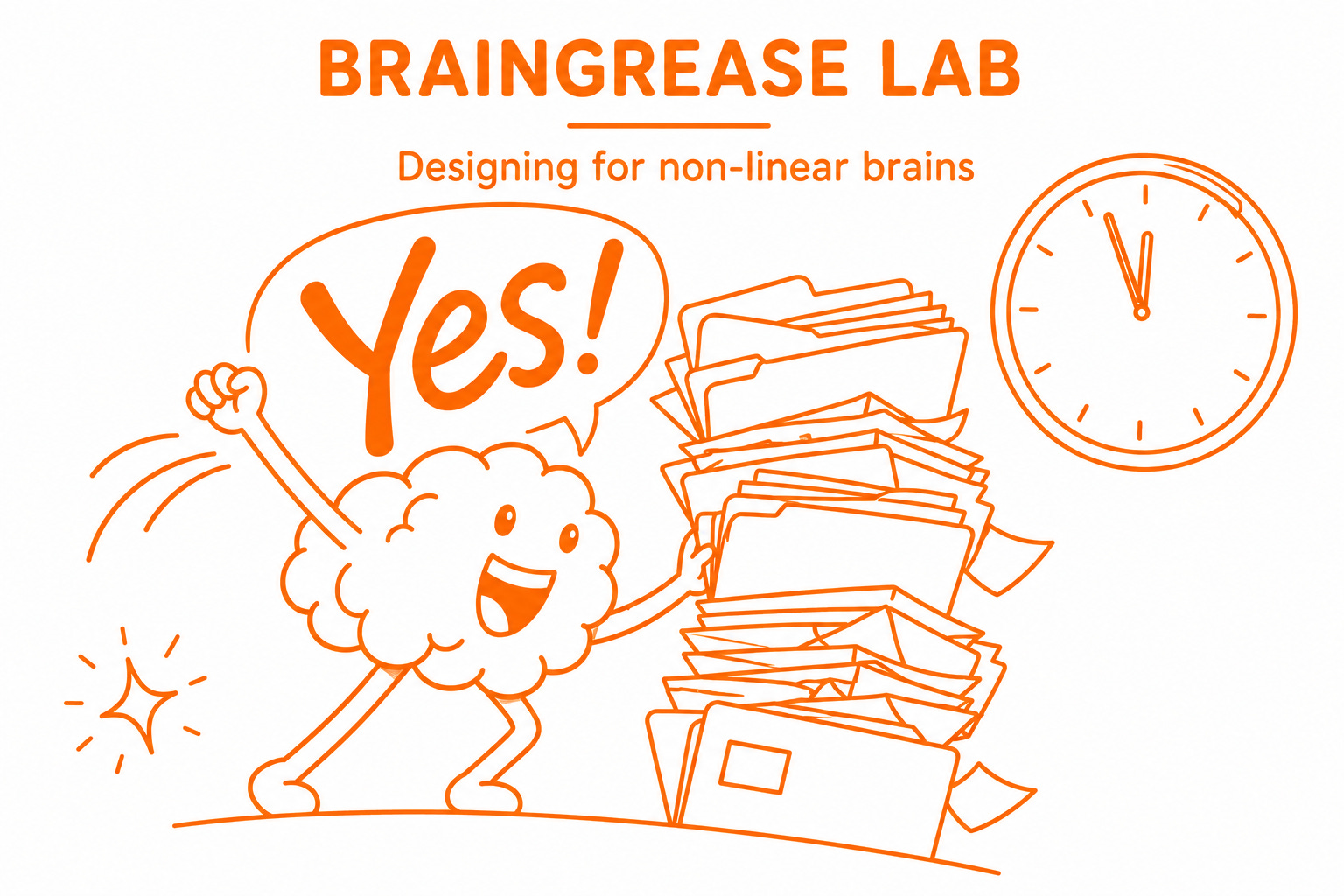
I’ve spent a lot of my career doing this. Saying yes before any part of my brain responsible for checking capacity had weighed in. And for a long time I thought it was a character thing — that I was too eager, too conflict-avoidant, too desperate to prove I belonged. It took getting late-diagnosed to understand that while all those were true, there was a little more going on behind the scenes.
There isn’t any one reason the “yes” comes so easily. I’ve noticed there are at least five different reasons I am quick to say yes.
The novelty yes. A new project appears. It’s novel, it’s complex, and different from everything I have on my plate. My brain lights up. It’s exciting. The problem is that enthusiasm isn’t capacity. The dopamine of a new project doesn’t tell me anything about whether I can actually deliver it three weeks from now, when the novelty has worn off and it’s become another thing competing for the same depleted attention.
If you've ever started a project with full conviction only to find it stalled two weeks in, this might explain why.
The working-memory-collapse yes. Three weeks feels like an open field. Next month feels practically fictional. So I say yes because the deadline seems far away. But it’s a calendar illusion. Between now and then there are meetings, decisions, follow-ups I’ve been avoiding, and at least one task that will take four times longer than I want it to. The future looked spacious because I’d forgotten all the stuff that I actually had to do between saying “yes” and the deadline.
The Imposter Syndrome yes. This is the yes that comes from fearing that I’m not good enough. From not wanting to look slow, overwhelmed, or incapable of the opportunity. I’ve spent a professional life living with the private suspicion that I’m not as competent as people think. “Yes” becomes a kind of armour. If I can prove I can take on anything, maybe people won’t notice.
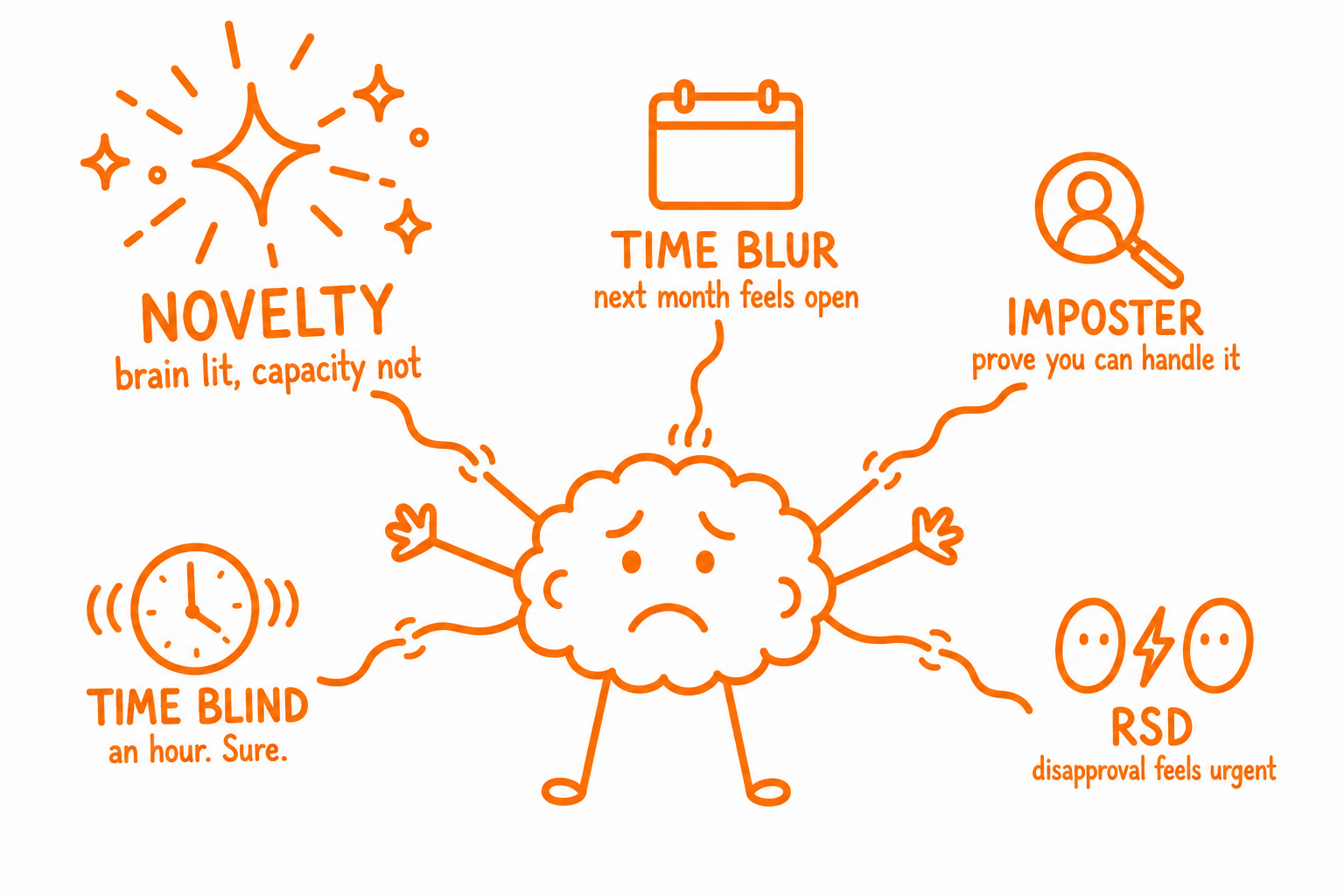
The RSD yes. Someone I respect makes a request. Or I sense they might be disappointed if I decline. And my nervous system fires the answer before my brain has had a chance to weigh in. It doesn’t matter if the person asking is my boss or a passing acquaintance. The possibility of their disapproval, real or imagined, registers as urgent. So I say yes to neutralize it. I end up committed to things I didn’t choose because saying no felt like a risk I couldn’t afford.
The time-blindness yes. The yes because “This should only take an hour.” It won’t take an hour. It’ll take an hour to reread the background, another to remember the context, another to deal with the unexpected wrinkle, twenty minutes to find the old email, and then some extra time at the end because now it’s late and I’m trying to compensate for the lateness with quality. Not being able to realistically estimate how much time something will take is one of the biggest reasons I over-commit.
Time blindness makes every deadline feel theoretical until it isn't
When there are so many reasons to say “yes”, it’s little wonder I have a plate-full of projects and to-dos, many of which are low-value, not scoped right, and eating time I could have spent on things that actually matter.
What it actually costs
I thought yes was building my reputation. That being available made me look reliable, ambitious, like the kind of person who could be trusted with important work. Some of that was true, especially early on. When you’re first starting out, being flexible matters. Being willing to stretch matters. And nearly every project you take on is a learning opportunity.
One cost to always saying “yes” is burnout. Adding to your plate indiscriminately will do that to you. That’s pretty obvious.
But there are other equally costly consequences. Lack of trust for one. Saying “yes” to projects when you are overloaded and don’t have the bandwidth can be dangerous. You don’t give the project the attention it deserves. You half-ass it and turn in something substandard, and maybe even late. And just like that you’ve lost credibility. Reliability builds a reputation. Availability alone doesn’t.
Or you become known as someone who never says no, so your colleagues start passing you the less desirable work, the low-stakes projects, the messy administrative project that they had the self-preservation to decline. And pretty soon, your plate is stacked with the kind of work that makes sure you’re very firmly planted in your spot with little room for advancement.
And all that low-stakes, grunt work you’ve been saddled with means you don’t have the space to take on the more meaningful, strategic, interesting projects.
So the strategy to always say “yes” backfires spectacularly. You thought it would get you the visibility to prove yourself and move up the ladder. Instead it landed you in overwhelm with the reputation for being the person who can be saddled with planning the office potluck.
A different way to think about no
Saying no to the wrong things is what keeps me available for the right ones.
No used to feel like failure. Like evidence that I couldn’t handle as much as other people. Now I see it as a capacity strategy — preserving the bandwidth for the work where I can do something good. Preventing a fake yes from becoming a real disappointment. Making my commitments mean something.
I’m not trying to say no more. I’m trying to say yes to fewer, better things.
One of the tricks to saying “yes” intentionally is to know how much capacity you have. My default is that I have capacity for new things — whether it’s work or play. Which of course is wrong. So, I try to get a gauge of my capacity on a regular basis and a rough idea of how much time I actually have so I can take on new things.
1. Make the capacity decision before someone asks.
Make a list of all your active projects. I keep a running list of all my active projects — nothing fancy, just a simple list with the name of the project. The list is separated into High, Medium and Low/Ad-hoc — based on effort and intensity. The list is always at the top of my daily task list, so I have a quick visual of what’s on my plate. I use a simple heuristic — for example, at any given time I can have 3 High, 6 Medium and 8 Low projects.
I write more about daily capacity here
Visualize your actual available time. Another way I visualize capacity is to block my calendar with how much time I’m expected to give my various projects and see what’s remaining. This isn’t time blocking. What I’m doing is blocking out chunks of time I think the various projects need in any available time slots around meetings and other fixed commitments to see what is realistically left over.
Halve any available time. Then I take whatever is left over and halve it, to account for last-minute emergencies, low energy days and other factors. The remainder is time I have for anything new. Any new request gets compared to the leftover time before I make a decision.
With this I have a rough idea of the type of projects I can take on and the capacity I have to do it. I try to keep this information visible somewhere I can see it daily — like my daily OneNote task sheet — so I have it ready when a request comes in.
Then it becomes a matter of: do I have a space on my project list for this task, and will it fit into my available time? And if I really want to take it on, what project or recovery space will I be stealing time from?
Build a default response.
Here’s my default response: “Let me check what I have on and get back to you.”
That’s it. No apology. No detailed explanation of my workload, calendar density, or brain chemistry. Just a pause. It’s taken some practice, but I’m getting there.
Buying yourself time before saying “yes” does a few things. It makes you pause and reconsider whether this is something you actually want to do. As you sit with the decision, some of the initial excitement and novelty that prompts that “yes” may wear off and you’ll see the project for what it really is. That instinct to say “yes” so people will like you takes a back-seat and gives you time to formulate a more appropriate response. You have time to go back and check on your capacity to see if you actually have the bandwidth.
Sometimes I’ll check and the answer is yes. Sometimes it’s “I can’t take this on by that deadline, but I could look at it next week.” Sometimes it’s “I’m not the right person for this.” Sometimes it’s “I can do a smaller piece.”
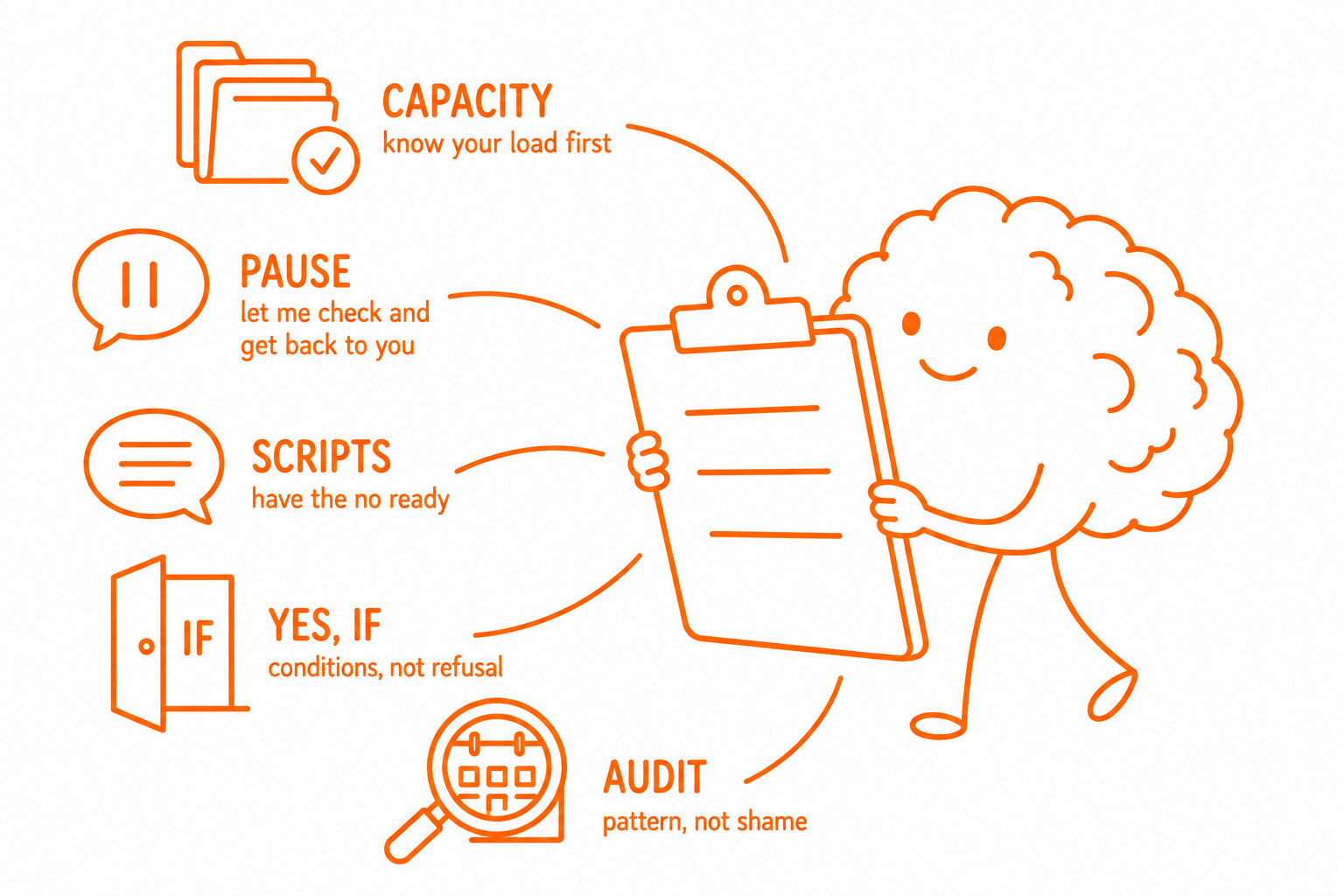
Have pre-written scripts.
Improvising a no under social pressure is where guilt and over-explaining sneak in. I find it easier to have a few sentences ready in advance. “I’m at capacity right now, so I can’t take this on properly.” “I’m going to pass — I don’t have the bandwidth to do it justice.” “I’m not the right person for this. This is something the xyz department should be handling.” If you find saying “no” hard because of the emotional guilt around refusing to help, it may be worthwhile to have a refusal script ready that you can use without having to come up with something on the fly when you’re dealing with the emotional weight.
If you simply can’t refuse a project or an ask, consider whether “yes, if” works. Yes, if the deadline moves. Yes, if this becomes the priority over the other thing. Yes, if the scope is a review rather than ownership. “Yes, if” is underrated. It keeps the door open while making the conditions explicit. You’re not refusing the project, but adding clear boundaries to the ask.
Audit the yesses you’ve already given.
Look at your current commitments and ask: which of these did I say yes to because I was excited for about twelve seconds? Which did I accept because the deadline felt far away? Which did I take because I was afraid of looking uncommitted? Which did I underestimate?
This isn’t an exercise in shame. It’s pattern detection.
If most of your overcommitments come from enthusiasm, you need a cooling-off rule before you commit to anything novel. If they come from fear, the default pause sentence is your most important tool. If they come from time blindness, you need calendar blocks. If they come from effort underestimation, you need the halving rule.
One fix won’t catch all five yesses. But a small system can catch enough of them.
Some of those yesses can be delegated — though that comes with its own ADHD tax.
I don’t want to become someone who never stretches. Some of the best opportunities in my career came from saying yes to something messy, inconvenient, or slightly beyond my current role. The problem wasn’t saying yes — it was saying yes reflexively, before any part of my brain responsible for checking capacity had weighed in.
A deliberate yes is powerful. It means something. It’s a signal that I’ve actually considered the work, that I understand what it requires, and that I intend to deliver. A reflexive yes is the opposite. It may look like helpfulness but eventually it erodes exactly the reputation it’s trying to build.
I want to be trusted with important work. I want people to know that when I say I’ll do something, it gets done. That requires me to be selective — to pause before the commitment becomes real, and to stop treating future-me like an infinite resource.
The system isn’t perfect. I have a project on my plate right now that I said “yes” to because at the time I thought it was exciting, but it’s really a lot of grunt work. I still say yes sometimes when I don’t have the capacity. It’s not perfect, but it’s a lot better these days.
What's the hardest part of saying no for you — the guilt, the fear of looking incapable, the RSD, something else entirely?
This article is gold dust, thank you. I’m constantly saying yes due a combination of fear of missing out, shiny new projects and people pleasing. I’d put in strategies to address some of it but not in the holistic way you set out here. Definitely going to review my systems (when Im back from holiday of course!).