
Stop planning the same day every day for your ADHD brain
The 90-60-30 capacity system — so I can get things done without the burnout.

It’s 9:12am on a Tuesday and I’m staring at my calendar. Three floating blocks scheduled through the day. Inbox has seventeen emails that need responses. A dense report that needs to be submitted by end of week. My brain knows exactly what matters most today—I’ve got notes from yesterday, tabs already open, the whole thing queued up and ready to go.
Except my brain feels like it’s wrapped in cotton. I’ve read the same paragraph in this email four times and still couldn’t tell you what it says. The words are there but they’re not landing. This is what a high-ADHD morning looks like for me
This used to feel like a failure. Like I just needed to summon more discipline, power through, prove I could do the work I’d committed to doing. Prove I could deliver consistently.
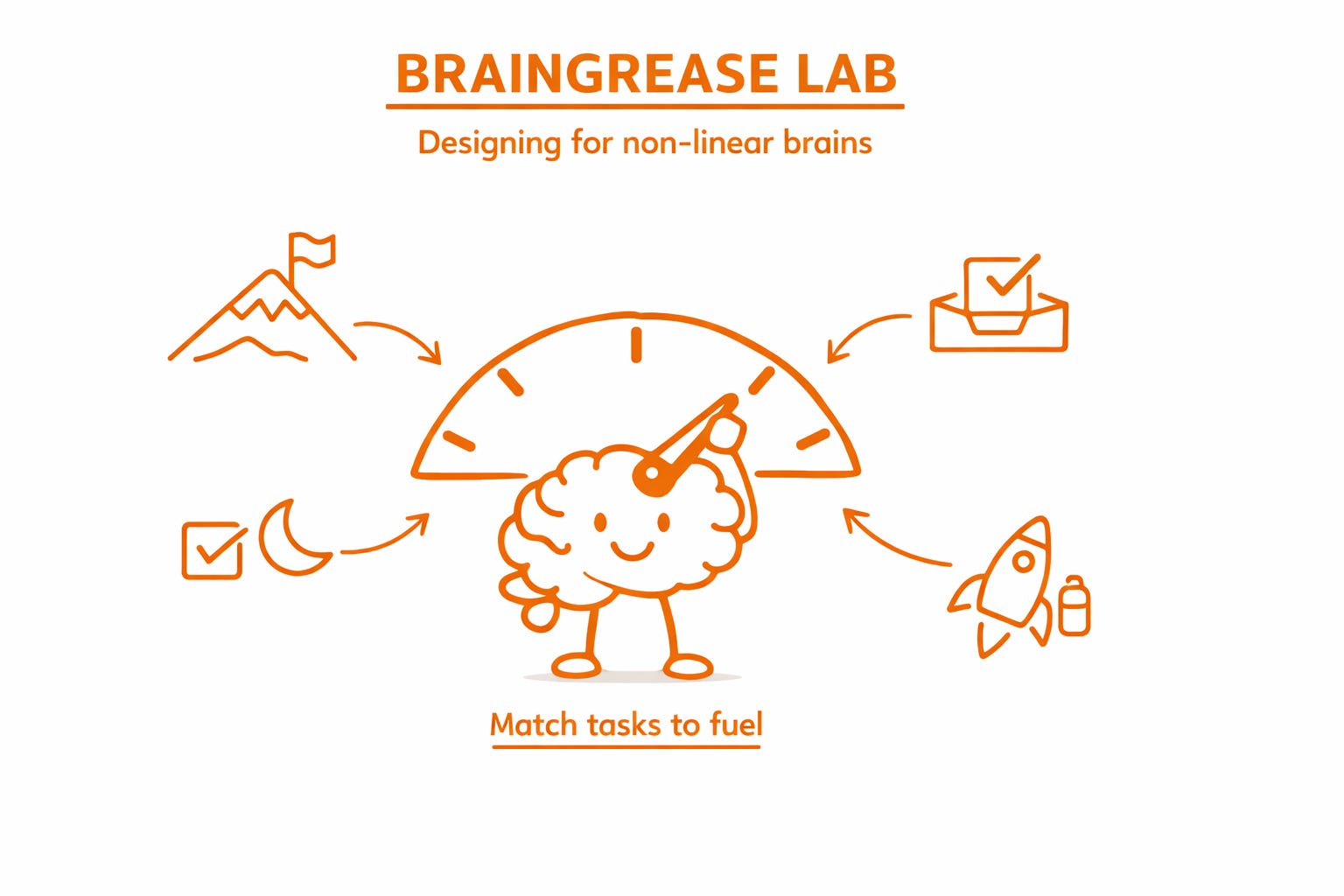
But the problem isn’t inconsistency. The problem is trying to run a 100% plan on a 40% brain.
The pandemic gave me something I didn’t expect: working from home gave me autonomy over when and how I worked. As long as I was responsive and delivered outputs, I didn’t have to demonstrate constant production. Remote work meant I didn’t have to look busy all the time, I just had to deliver.
That’s when I figured out what worked for me was matching tasks to capacity instead of forcing a fixed plan every day. That’s when the 90-60-30 mode week started to take shape. This is what drives my “choose your own adventure” for my Timeblocking System.
To learn more about my timeblocking system: Timeblocking Failed My ADHD Brain. Here’s What I Use Instead.
The 90-60-30 Mode Week
90% Mode
What it is: My ideal morning looks like this— a cup of tea, read Substack, deal with the pets, tidy up a bit, get ready, at my desk by 8:30. When that sequence completes without friction, it’ll probably be a 90% day. My brain has what it needs. (I say probably. With ADHD, you never really know. Sometimes things could go sideways for no apparent reason.)
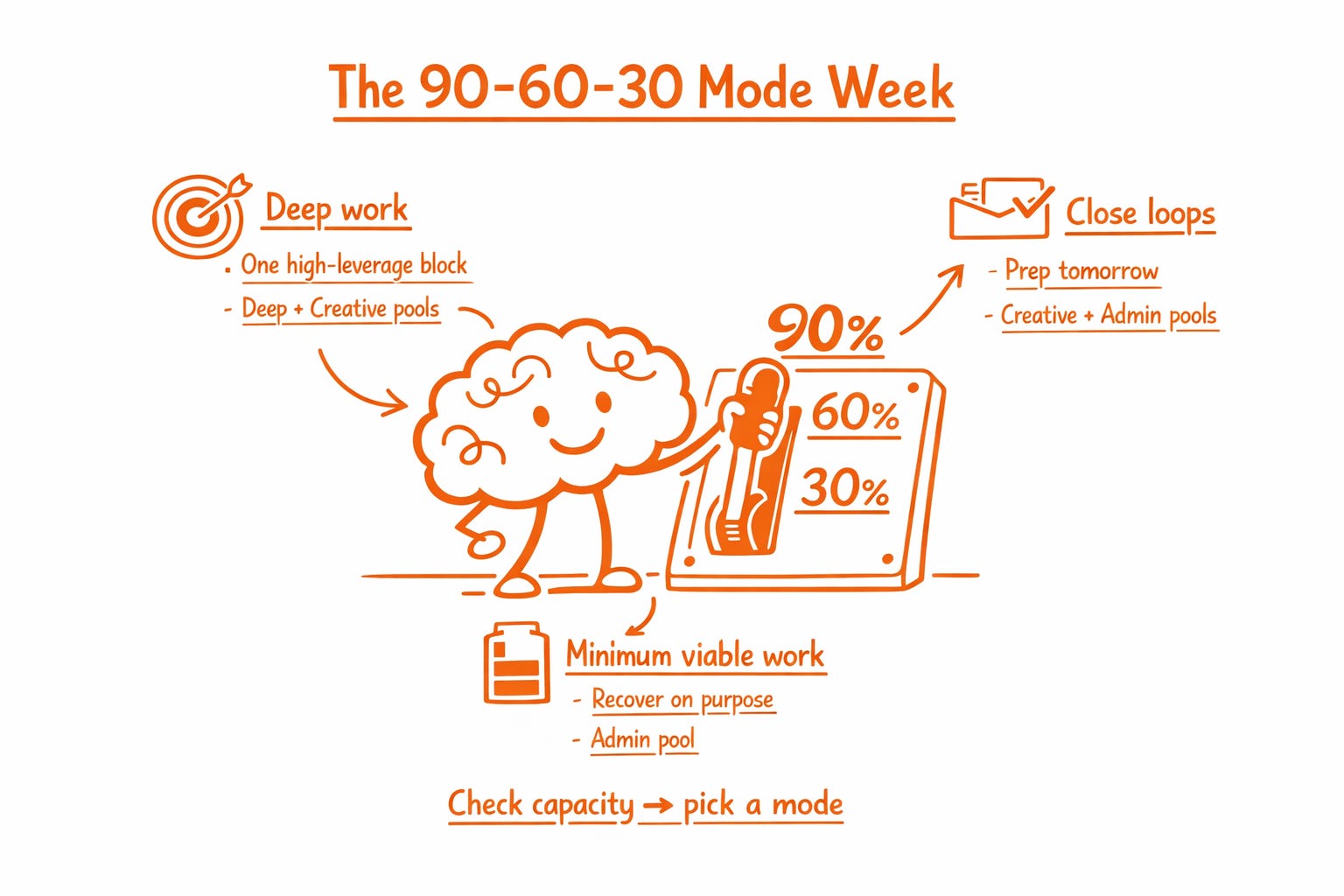
How I work it: When I’m having a 90% day, my first flexible time-block, which is typically in the mornings when my brain feels sharp, is my Deep Work block. I try to keep it to ONE Deep Work block, I pick ONE high-leverage block of deep work— drafting a complex document, working through a thorny analysis, or making a decision that requires a lot of thought and research. These are the days for the kind of work that actually moves things.
Task Pools used: If you’ve read my article on ADHD time blocking, you’ll remember that I categorize my tasks into pools. I’ll pull tasks from my Deep Work and Creative Chaos task pools for my 90% days.
60% Mode
What it is: Some mornings the cat decides he’s not going to use the litterbox. Or my mom calls with something she needs to vent about. Or I wake up late and the whole sequence gets compressed. Or work starts with a status meeting I wasn’t expecting.
Those disruptions aren’t just annoying—they are draining. Problem-solving before work, sitting through meetings during my most focused hours, dealing with something personal first thing—all of it burns through the fuel I need for focused work later.
While I’m not my sharpest, I’m not necessarily depleted either. On these 60% capacity days, my brain can handle medium-complexity work but not the hardest stuff.
How I work it: These are close-the-loops days—replies, approvals, quick decisions. I also use these days to prep tomorrow’s deep work: open the tabs, write the first sentence, create an outline. That way if tomorrow is a 90% day, I can jump straight into momentum instead of spending 20 minutes figuring out where to start.
Task Pools used: Typically, I pull tasks from my Creative Chaos pools and my Admin pools.
30% Mode
What it is: And then there are days when my brain is foggy from the start. Bad sleep, an emotionally draining morning, or just waking up depleted for no obvious reason. Also, days around my period - these tend to be high ADHD days when I’m just a ball of continuous distraction.
And forcing high-friction work on such low-capacity days doesn’t save time. It doubles it, because whatever I produce has to be redone anyway.
How I work it: On these days I do minimum viable work: respond to anything time-sensitive, reset one expectation early so people aren’t waiting on me, and find one 10–20 minute task I can actually complete. Maybe it’s the day I sit back with some knitting and listen to that webinar I’ve been putting off. Or organize my desktop. If I can move the needle somewhere, that’s enough. Even if it’s something that wasn’t on the original plan for the day.
Or I will intentionally take the time off and make it up when I have a 90% day. I recover on purpose instead of grinding away at work that’ll need to be redone anyway.
Task Pools used: These are the days I’ll pull from my Admin pool.
When I sit down in the morning, I check my capacity and try to figure out if its a 90, 60 or 30 per cent day. 90% —deep work. 60%—close loops. 30%—minimum viable professional, and I don’t pretend I’m capable of more than I am.
On Urgency as a Reserve, Not a Strategy
For me, urgency works as rocket fuel. I’ve mentioned this before. Critical deadlines can override my brain’s capacity signals and create artificial clarity. On a day that should be a 30%, a tight deadline can push me to something close to 90% — pure adrenaline carrying me across the line.
But running on urgency as a baseline is like sprinting a marathon. You can do it for a while. Then you crash. And I always do. These typically end in angry outbursts at my partner or an avalanche of tears because I can’t figure out what to eat.
I used to do this constantly—let things drift until the deadline created enough pressure that my brain would finally engage. It worked in the sense that I got things done. It didn’t work in the sense that it made for a terrible personal environment.
Now my goal is to treat urgency as a reserve, not a strategy. When something genuinely has to be done, I can override my capacity and push through. But I try not to structure my whole work life around manufactured pressure anymore.
Most of the time, I can wait for full faculties. When I do, things get done faster and better.
Why I Track What I Got Done
I also started tracking my weekly accomplishments—just a running list of what I got done. Not for anyone else. For me. It does two things: it’s visual proof that I’m making progress, and it’s emotional regulation on 30% days.
When I’m foggy and it feels like I’m falling behind, I can look at the list and see that I had two 90% days earlier in the week where I moved meaningful work forward. That helps lessen the guilt on my less than productive days and helps give me permission to get the rest I need.
Where to Start
Not every day is a 90% day. For me, accepting that was most of the work.
If you only try one thing from this: Monday morning, check your capacity. Did the morning routine complete smoothly or did something derail it? Does your brain feel sharp or foggy? Can you hold onto complex information right now?
Then pick one thing from the right category. 90% day—tackle something hard. 60% day—close loops and prep tomorrow. 30% day—minimum viable professional, then recover on purpose.
You don’t have to power through every day. You just have to build something that works with your actual brain.
What's your minimum viable task on a 30% day? I'd love to build a list from your answers.
Love this article! On a 30% day I can move some of the photos from my phone to my photo storage, and choose those that I need for my next article. Then I can go for a walk with the dog and take more photos.
I feel like everyone’s ADHD journey - the patterns they recognize and the ways they cope - can be different, but I’m so struck at how much your experience mirrors my own. Thank you for this.
On one of those 30% days, if I can clear out and delete a bunch of old spam from my work inbox, i’ll feel like I did something… anything…